Stream Structure
 View all Salmon Habitat Indicators
- Ecosystem Recovery Goal
- Functioning Habitat
- Vital Sign
- Streams and Floodplains
- Indicator
- Stream Structure
- Indicator Type
- Salmon Habitat Indicator
- Measurement Unit
- Count (pieces per 100 meters)
- Indicator Trend / Target Status
-

- Target
- No targets are currently set for this indicator.
- Salmon Habitat Indicator Reporter
- Marisol Ortega
mortega@example.org
Northwest Indian Fisheries Commission - Contributing Partners
- Last Updated
- 03/12/2026
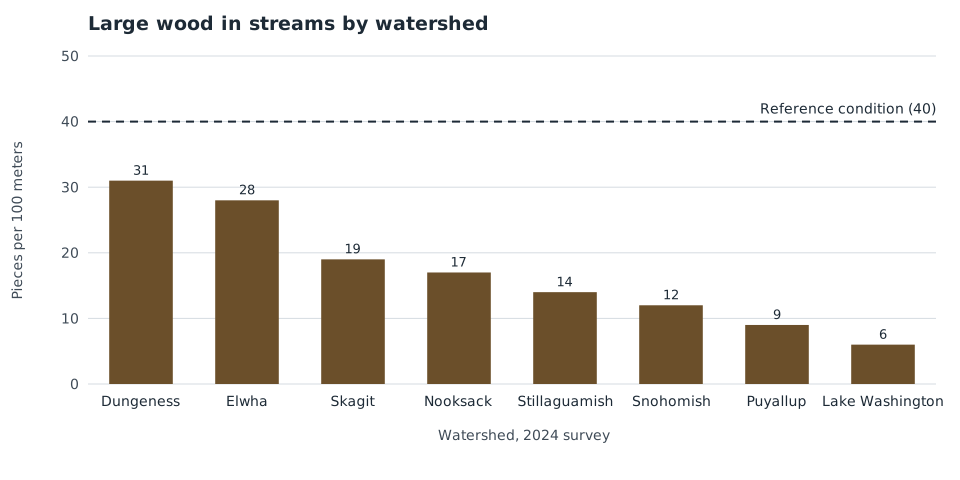
This indicator counts pieces of large wood and pools per 100 meters of channel in salmon-bearing reaches, summarized by watershed. Large wood is a log at least 10 centimeters across and 2 meters long lying in or over the active channel; a pool is a slow, deep unit at least as long as the channel is wide.
Logs, jams, and deep pools create the cover and resting water that spawning adults and rearing juveniles need. Many Puget Sound streams hold a fraction of the wood and pools they had historically.
- All eight surveyed watersheds hold less large wood than the reference condition for unmanaged forested streams.
- Watersheds with large areas of protected forest in their headwaters, such as the Dungeness and Elwha, hold the most wood and the most pools per 100 meters.
- Results are limited to the reaches surveyed in 2024 and cannot yet be compared over time.
Monitoring Program: Stream habitat surveys, Northwest Indian Fisheries Commission member tribes
Data Source: Stream habitat surveys compiled by the Northwest Indian Fisheries Commission
Methods
Survey crews walk salmon-bearing reaches at summer low flow and count every piece of large wood and every log jam in or over the active channel, then measure the length and depth of each pool. Counts are reported per 100 meters of channel and summarized by watershed.
Critical Definitions
- Large wood: a log at least 10 centimeters across and 2 meters long, lying in or over the active channel.
- Pool: a slow, deep channel unit at least as long as the channel is wide.
- Reference condition: the median count for unmanaged forested streams of similar size and gradient.
Low wood counts reflect a century of stream cleaning, splash damming, and riparian logging. Wood recruited from young riparian forests is small and moves downstream in floods, so counts recover slowly even where the riparian forest has grown back.
Causes for Change
Placed wood from restoration projects raises counts locally within a few years. Natural recruitment from riparian forest takes decades.
References
Fox, M., and S. Bolton. 2007. A regional and geomorphic reference for quantities and volumes of instream wood in unmanaged forested basins of Washington State. North American Journal of Fisheries Management 27: 342 to 359.
- Stream habitat survey reaches and counts, 2024 (Northwest Indian Fisheries Commission)
Methods are in development. Report survey results by watershed until a soundwide sampling design is adopted.
Watershed: Dungeness, Elwha, Skagit, Nooksack, Stillaguamish, Snohomish, Puyallup, Lake Washington