Summer low flow in streams and rivers
The summer low flow indicator measures current conditions and long-term trends in streamflows that occur during summer months when there is less rain and temperatures are warmer. The indicator tells us how often summer flows are below normal, relative to a 50-year baseline, in unregulated streams and rivers across Puget Sound. When flows are below normal, less water is available for people and wildlife to use, less habitat is available for salmon, and it can contribute to increased water temperatures and lower water quality.
Key Vital Sign Indicator Results
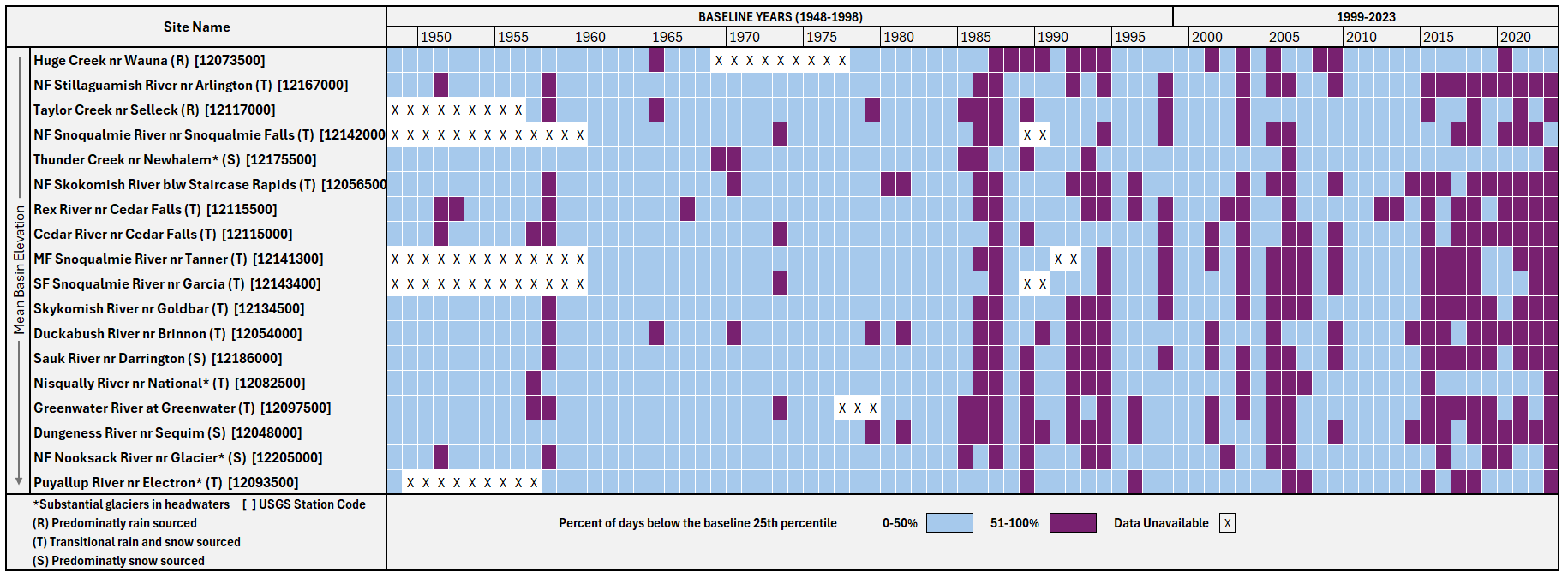
- The occurrence of below normal summer flows is increasing in unregulated streams and rivers across Puget Sound. In 2023, summer flows were below normal most of the time at 16 of the 18 indicator gages (see Interpretation of Results for more details). Thus, we determine this indicator to be GETTING WORSE.
- Consecutive years with below normal summer flows have increased since 1985 and especially since 2015. Since 2015, most of the rain, transitional, and snow-fed watersheds had below normal summer flows over 60% of the time.
- Accelerated glacial melt may temporarily offset diminishing low flows in some rivers. Summer flows are enhanced by glacier meltwater at four of the indicator gages. These systems have generally fewer occurrences of below normal flows during the summer flow period.
- Flows below 1948-1998 baseline minimums were observed at least once at all indicator gages during the 1999-2023 study period. The occurrences of flows below baseline minimums have increased since 2015. In 2023, 7-day mean daily flows below baseline minimums occurred greater than 50 percent of the time at 9 of the 18 gages in the analysis.
- Supporting analysis shows that the timing of streamflow is changing in Puget Sound. Between 1948 and 2023, the center of timing (CT) at most indicator gages regressed to earlier occurrences over time. This means the low flow season in our region is becoming longer as larger fractions of total annual runoff occur progressively earlier in the year (see Interpretation of Results – Changes in Streamflow Timing for more details).
 Importance to Salmon
Juvenile coho, steelhead, and stream-type Chinook spend one or more summers in freshwater, and adult Chinook and sockeye hold in rivers through late summer before spawning. When summer flows drop, riffles go shallow, side channels disconnect from the main stem, and the area of usable rearing habitat shrinks.
Low flows also warm faster and hold less dissolved oxygen. Crowding into the pools that remain raises competition and predation, and shallow riffles can block adult migration to upstream spawning grounds.