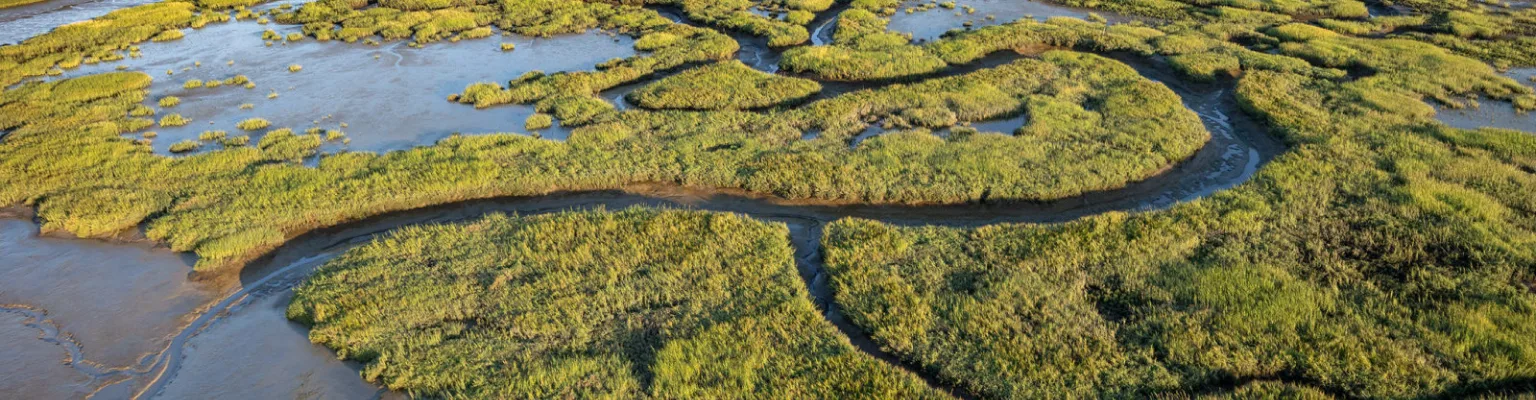
Aerial view of a tidal marsh with a researcher
WRMP

Science Framework

The Guiding Questions, Management Questions, and Priority Recommended Actions that focus all WRMP monitoring science.

The WRMP’s science framework ensures the Program’s science stays relevant, actionable, and tied to its mission. Each Guiding Question below is paired with interactive exhibits — small, illustrative looks at how the monitoring work is progressing against that question.

About the Science Framework

All WRMP science activities are designed to answer practical Guiding Questions, Management Questions, and Priority Recommended Actions developed by the Steering Committee. The Technical Advisory Committee and Workgroups develop key indicators, metrics, and protocols for monitoring based on each of the Management Questions.

In addition, nested under the Management Questions are Monitoring Questions designed to answer the management issue at hand. The Monitoring Questions are often technical and detailed in nature — they are not included on this page and are instead summarized in the WRMP’s Monitoring Matrix. Read more.

Guiding Question 1

Where are the region’s tidal marsh ecosystems, including tidal marsh restoration projects, and what net changes in ecosystem area and condition are occurring?

Management Question 1A

What is the distribution, abundance and condition of tidal marsh ecosystems, and how are they changing over time?

View all exhibits for this question
Management Question 1B

Are changes in tidal marsh ecosystems impacting water quality?

Priority Recommended Action

Conduct regional baseline and subsequent routine surveys and inventories of the distribution, abundance and condition of tidal wetlands throughout the region, using existing tools and metrics to the extent practicable and developing new tools and metrics where necessary.

Guiding Question 2

How are external drivers, such as sea level rise, development pressure, and changes in runoff and sediment supply, impacting tidal marsh ecosystems?

Management Question 2A

How are tidal marshes and tidal flats, including restoration projects, changing in elevation and extent relative to local tidal datums?

View all exhibits for this question
Management Question 2B

What are the regional differences in the sources and amounts of sediment available to support accretion in tidal marsh ecosystems?

Priority Recommended Action

Establish Benchmark Sites and other components of the WRMP monitoring site network (dependent on available funding and resources), and analyze WRMP data collected to answer Guiding Question 1 together with non-WRMP data on external drivers to track external drivers as potential causes or correlates of tidal marsh change.

Guiding Question 3

What new information do we need to better understand regional lessons from tidal wetland restoration projects in the future?

Management Question 3A

What new information do we need to better understand regional lessons from tidal marsh restoration projects, advance tidal marsh science, and ensure the continued success of restoration projects?

View all exhibits for this question
Management Question 3B

Where and when can interventions, such as placement of dredged sediment, reconnection of restoration projects to watersheds, and construction of living shorelines, help to sustain or increase the quantity and quality of tidal marsh ecosystems?

View all exhibits for this question
Priority Recommended Action

Analyze WRMP data collected to answer Guiding Questions 1, 2, and 4 with new data on the relative roles of estuarine and upland/watershed sources of sediment to counter the threat of sea level rise. Other drivers will be addressed in later WRMP phases.

Guiding Question 4

How do policies, programs, and projects to protect and restore tidal marshes affect the distribution, abundance, and health of plants and animals?

Management Question 4A

How are habitats for assemblages of resident species of fish and wildlife in tidal marsh ecosystems changing over time?

View all exhibits for this question
Management Question 4B

How are the distribution and abundance of key resident species of fish and wildlife of tidal marsh ecosystems changing over time?

View all exhibits for this question
Priority Recommended Action

Repeat surveys (detect change) of living organisms and their habitats (indicators), and standardize the metrics and reporting for indicators that are common to projects and baseline/subsequent ambient monitoring across the range of project designs and restoration practices.

Guiding Question 5

How do policies, programs, and projects to protect and restore tidal wetlands benefit and/or impact public health, safety, and recreation?

Management Question 5A

What mosquito and vector control strategies need to be considered in restoration design and management to understand the effects that restoration can have on mosquito and vector populations?

Management Question 5B

What monitoring data and/or analyses are needed to improve the relationships between tidal marsh restoration, fish and wildlife support, mosquito and vector control, and public access?

Management Question 5C

How are the benefits of wetlands (such as flood risk reduction, water quality, public access, opportunities for community stewardship, knowledge production and transmission, and cultural and spiritual experiences) distributed regionally?

Management Question 5D

How does the provision of benefits (such as flood risk reduction, water quality, public access, opportunities for community stewardship, knowledge production and transmission, and cultural and spiritual experiences) progress over time at existing and restored wetland sites?

Priority Recommended Action

Monitor the broad range of interactions between people and wetlands for the safety of people and health of the marshes. Better integrate flood control and mosquito and disease vector control into project planning and assessment, and similarly integrate wetland restoration into flood control planning. Continue to grow the WRMP to assess the effects of shoreline adaptation on relationships between people and nature.
Where are we monitoring?

The WRMP conducts monitoring throughout the San Francisco Estuary, including San Pablo, South, and Suisun Bays, within priority Operational Landscape Units.

View the monitoring site network

What metrics are monitored?

WRMP metrics assess wetland function and restoration site development — water quality and depth, vegetation, condition, sediment, and fish habitat.

View in-progress and future metrics

Looking for more information?

Explore how the WRMP developed the foundation of these monitoring efforts through the Program Plan, Monitoring Plan, and Monitoring Matrix.

Science Framework resources