Vital Sign Indicators
View in Vital Signs Eelgrass Area
- Ecosystem Recovery Goal
- Functioning Habitat
- Vital Sign
- Beaches and Marine Vegetation
- Indicator
- Eelgrass Area
- Indicator Type
- Vital Sign Indicator
 Salmon Habitat Indicator
- Measurement Unit
- Acre (acres)
- Indicator Trend / Target Status
-

- Target
- No targets are currently set for this indicator.
- Vital Sign Indicator Reporter
- Bart Christiaen
Bart.Christiaen@dnr.wa.gov
Washington State Department of Natural Resources - Contributing Partners
- Last Updated
- 12/30/2024
Soundwide eelgrass area is a metric for the overall health of native seagrass beds in greater Puget Sound. Seagrass is an important component of nearshore habitats and is sensitive to human disturbance and declines in water quality.
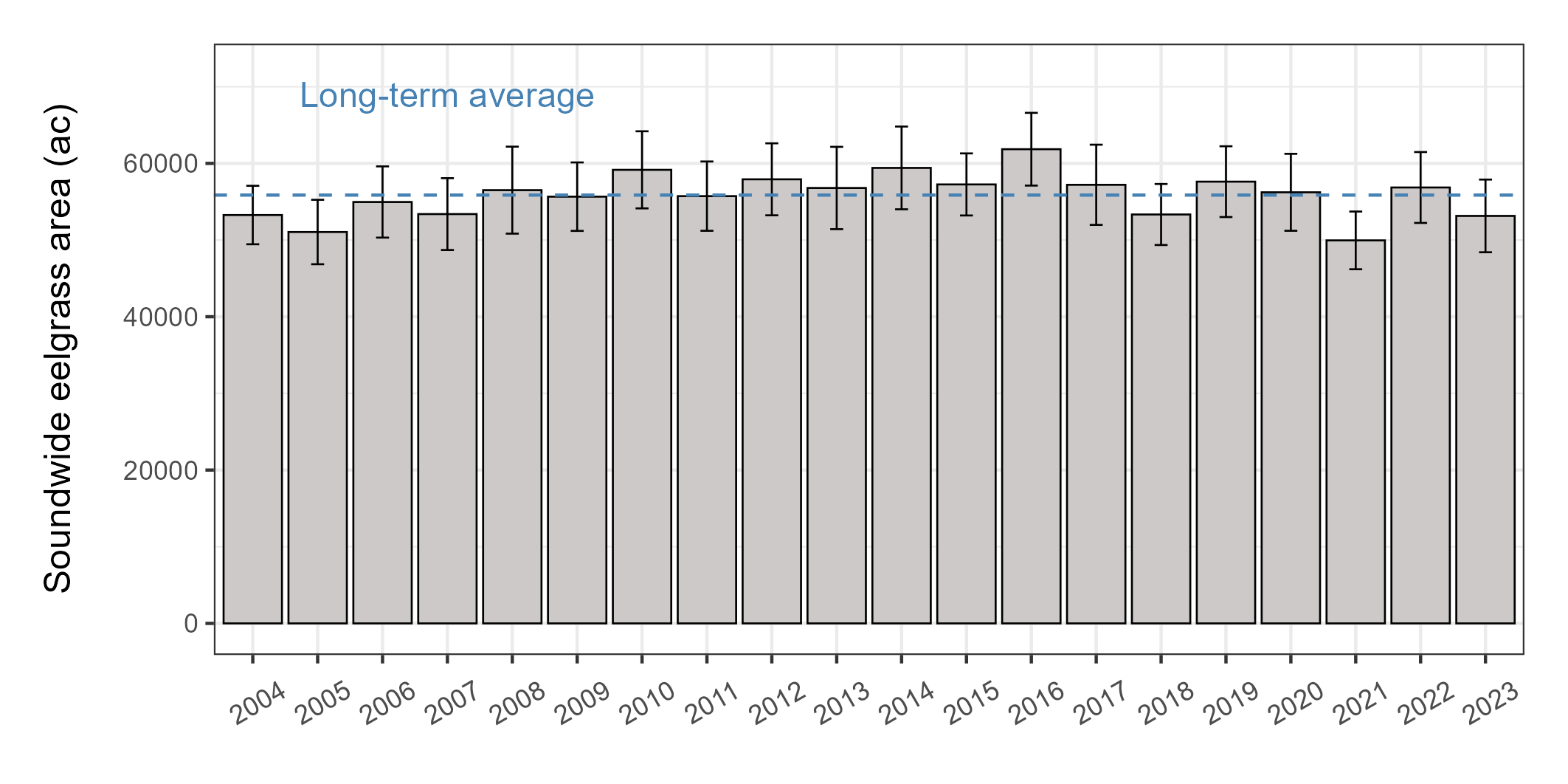
- The current best estimate of eelgrass area in greater Puget Sound is approximately 51,700 acres (pooled 3-year average 2021-2023).
- Soundwide eelgrass area showed an increasing trend between 2004 and 2016, and a declining trend between 2016 and 2023. The magnitude of these changes was relatively small compared to the total amount of eelgrass present in greater Puget Sound. The relative stability is reassuring and sets Puget Sound apart from many other developed areas, where substantial system-wide declines are ongoing.
- While most sites appear stable, the spatial pattern in site level trends suggests that eelgrass is susceptible to declines in certain areas of greater Puget Sound. For more information on regional patterns, see the short and long-term change at eelgrass sites indicator.
Importance to Salmon
Juvenile Chinook and chum leave their natal estuaries and move along shorelines in shallow water, where eelgrass beds offer cover from predators and a dense supply of small crustaceans and insects to feed on.
Eelgrass also shelters Pacific herring spawn, an important prey for salmon in their first months at sea. Losses of eelgrass along migration corridors can lower early marine growth and survival.